
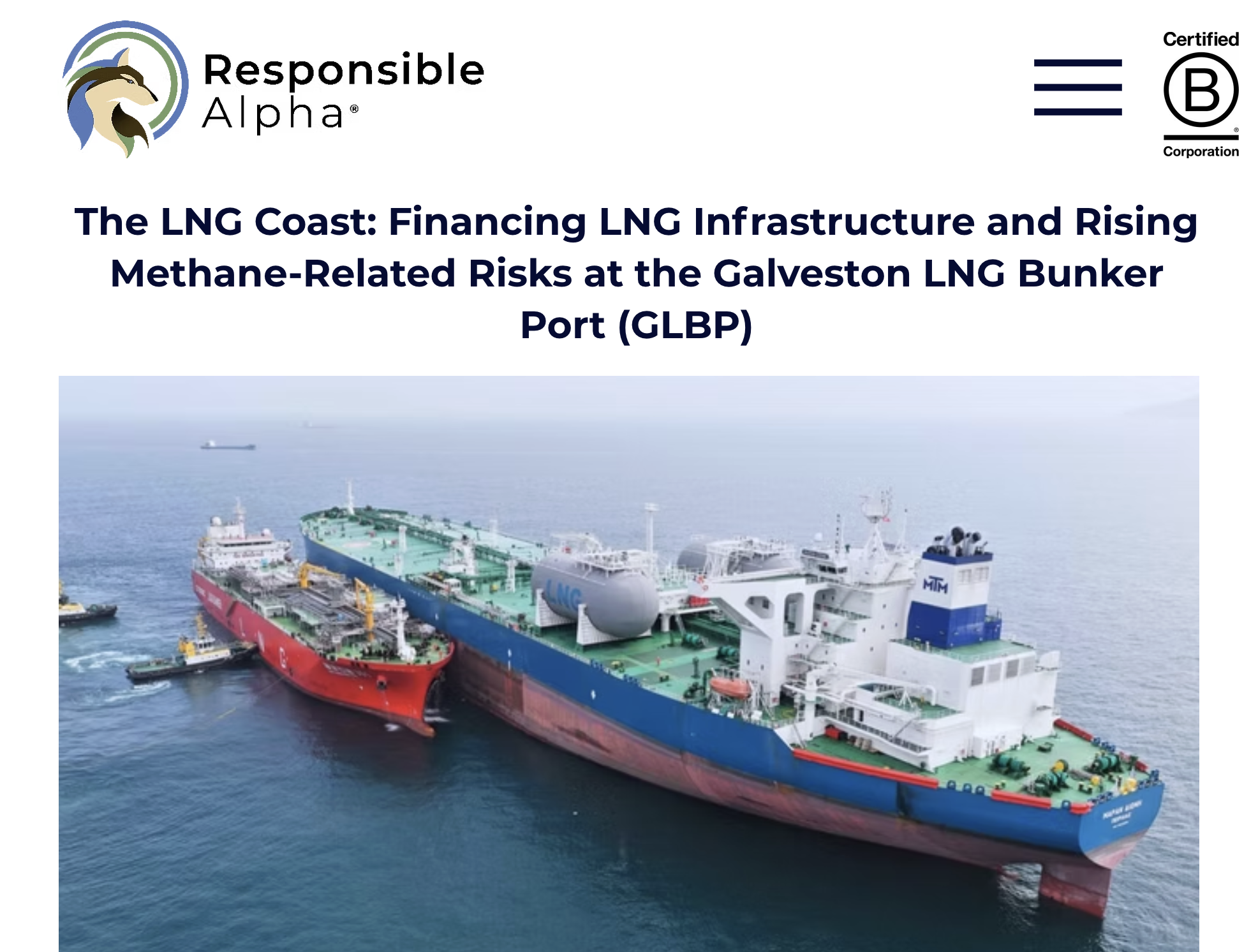
Analysis: Financing LNG Infrastructure and Rising Methane‑Related Risks at the Galveston LNG Bunker Port (GLBP)
Prepared for: Maritime Beyond Methane (MARBEM) | Prepared by: Responsible Alpha.
Along the U.S. Gulf Coast, a new generation of LNG infrastructure projects is emerging to serve the maritime sector. Among them is the proposed Galveston LNG Bunker Port (GLBP)—a pre-FID joint venture between Seapath and Navenergy Infrastructure Partners seeking to establish a dedicated LNG bunkering hub for the Houston–Galveston region.
Gulf Coast energy infrastructure often relies on long-term financing structures that expose lenders, municipalities, and communities to significant financial and environmental risks. GLBP fits squarely within this pattern: a capital-intensive, long-lived fossil-fuel asset whose revenue model depends on volatile commodity markets, uncertain demand, and tightening regulations.
This paper evaluates GLBP through integrating financial structure, public-risk exposure, market fundamentals, regulatory pressures, and community impacts. The findings indicate that GLBP’s business case is fragile, its credit profile is impaired under realistic volatility conditions, and its long-term competitiveness is eroding as the maritime sector moves beyond methane.