
The ICJ Advisory Opinion on State obligations in relation to methane and maritime fuel
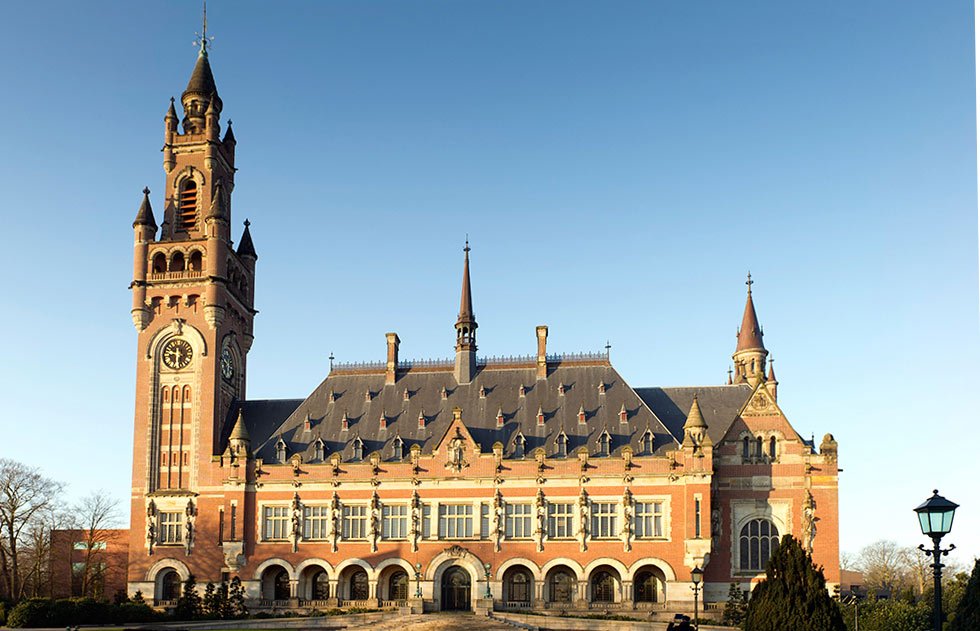
Photo from ICJ: The International Court of Justice, which has its seat in The Hague,
is the principal judicial organ of the United Nations
The ICJ Advisory Opinion obligations have direct implications for the United Nation’s International Maritime Organization (IMO) Net-Zero Framework. The ICJ requires that the Well-to-Tank default emissions factor for fossil LNG reflect full life-cycle LNG emissions and not use a methodology that selectively favours particular supplier basins or under-counts upstream methane.
Executive Summary
This brief examines the legal obligations that flow from the International Court of Justice (ICJ) Advisory Opinion on Climate Change (2025) as they relate to Liquefied Natural Gas (LNG) in the maritime shipping sector. The ICJ Advisory Opinion was rendered unanimously.
While advisory opinions are not legally binding, they contain authoritative interpretation of international law by the highest UN judicial authority and are a reference for States, international organizations, and national courts. Read alongside the Inter-American Court of Human Rights (IACtHR) Advisory Opinion on the Obligations of States regarding Climate Emergency and Human Rights (2025), these instruments establish two core obligations for States with respect to LNG:
Obligation 1: States must not promote LNG production or consumption along its full life cycle — including through subsidies, financing mechanisms, or enabling infrastructure.
Obligation 2: States must adequately regulate GHG emissions from LNG across the full well-to-tank life cycle, not solely onboard combustion, and must establish national enforcement frameworks that extend to private actors.
These obligations have direct implications for the United Nation’s International Maritime Organization (IMO) Net-Zero Framework. The Well-to-Tank default emissions factor for fossil LNG is scheduled for adoption at forthcoming IMO meetings. The ICJ requires that this default reflect full life-cycle LNG emissions and not use a methodology that selectively favours particular supplier basins or under-counts upstream methane.
Introduction
Last year brought important developments in international law on climate change. In May, the Inter-American Court of Human Rights (IACtHR) issued an Advisory Opinion on the Obligations of States regarding Climate Emergency and Human Rights, requested by Chile and Colombia, in which it developed the content of the human rights obligations of States Party to the Organization of American States in relation to climate change. Similarly, the International Court of Justice (ICJ) issued its Advisory Opinion on Climate Change at the United Nations General Assembly’s request. Particularly relevant is the Court’s analysis of States’ obligations around fossil fuels. The International Court of Justice concluded that States should not promote fossil fuels’ production and consumption. This is relevant to the use of LNG, a fossil fuel largely composed of methane, which is usually regarded as a cleaner alternative to traditional fossil fuels.
While the ICJ Advisory Opinion has generated extensive legal commentary since these developments, its application to Liquefied Natural Gas (LNG) as a marine fuel specifically has not yet been substantively addressed in the public legal literature. This text will focus on these obligations and what they mean for LNG within the context of the global maritime shipping sector.
Legal Weight and Scope of the ICJ Advisory Opinion
The legal technicalities about the advisory opinion:
It was rendered unanimously, which shows the incredible force of the consensus on the content of the legal obligations of States regarding climate change;
It possesses significant normative weight. As an authoritative interpretation of international law by the highest UN judicial authority, it exerts considerable influence on the development, application, and understanding of legal obligations for States, international organizations, and national courts; and,
The scope of the obligations is based on the climate change treaties, environmental treaties, the law of the sea and related issues, customary law, international human rights law, and certain interpretation principles.
LNG and Climate Change Obligations Under International Law
The demand for LNG in the world has increased because it has been characterized by some actors as a transitional energy source, its relatively lower energy cost, and its lower sulphur content. Nonetheless, besides its warming potential –methane is 82.5 times more potent than carbon dioxide over a 20-year period– it also has additional significant environmental and health impacts along its life cycle. In the atmosphere, methane reactions lead to the production of tropospheric ozone, carbon dioxide, and stratospheric water vapor, which are also GHGs. In light of this information, the use of LNG as a transition fuel is a serious threat to any State’s climate change mitigation efforts.
The Court referred specifically to fossil fuels when analysing the question of what might constitute an international wrongful act for States, and therefore make them legally responsible under international law. According to the ICJ, “the adoption of laws, policies and programs, including decisions that promote fossil fuel production and consumption, and failure to adequately regulate the GHG emissions under the State’s jurisdiction and control” are examples of breaches to the States’ obligations under international law. Similarly, the IACtHR held that the States have the obligation to guarantee that third parties do not infringe more harm therefore States must take all necessary measures to reduce the risks of climate change of vulnerable communities and groups. Out of these examples, one can conclude that States have at least two core obligations: first, they must not promote production and use of fossil fuels and, second, they must “adequately” regulate GHG emissions.
Obligation 1: States Must Not Promote LNG Production or Consumption
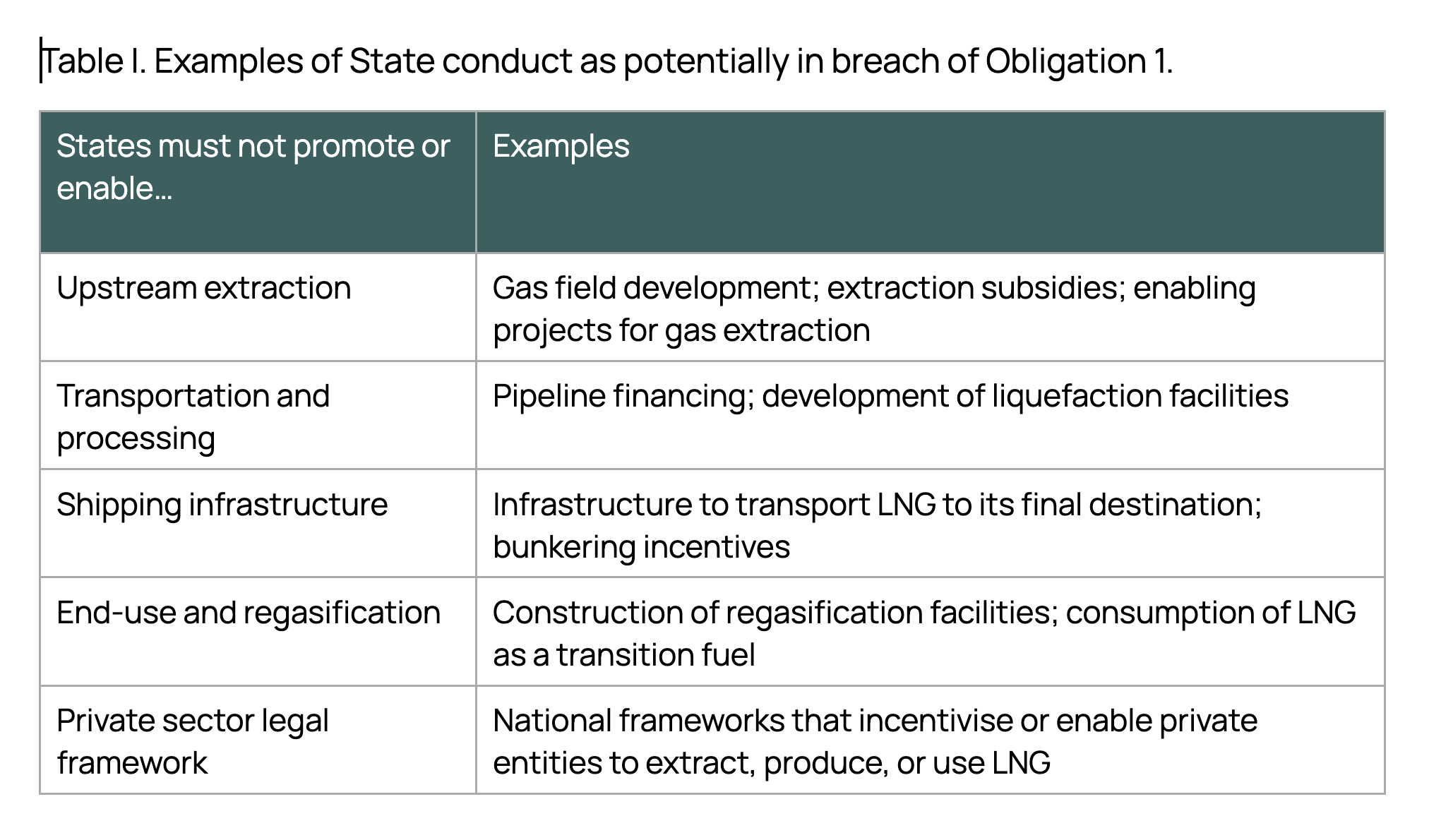
For the first obligation in the case of LNG, States have the duty to implement public policies that do not promote the production of LNG all along its life cycle and its use. That includes, among others, facilitating, subsidising, financing or enabling projects for the extraction of gas, the transportation of gas through pipelines, the development of liquefaction facilities, the shipping infrastructure to transport it to its final destination and the construction of regasification facilities, but also the consumption of LNG as a transition fuel. States are responsible for creating a national legal framework that prevents private entities from being incentivised or enabled to extract, produce and use LNG as a transitional energy source and fuel, including in the maritime sector, and to implement effective monitoring mechanisms for those private actors.
Obligation 2: States Must Adequately Regulate Full Life-Cycle GHG Emissions
Second, States must adequately regulate GHG emissions. This obligation can be unpacked in that, among others, States must have and implement a national system regulating GHG emissions. In order to conclude this, the ICJ recalled its own development of the obligation to act with due diligence in Pulp Mills on the River Uruguay, (Argentina vs Uruguay), Judgement, I. C. J. Reports 2010 (para. 101) stating that it means to “use all the means at its disposal to avoid activities which take place in its territory, or in any area under its jurisdiction, causing significant damage to the environment of another State”.
The Court also referred to the International Tribunal for the Law of the Sea’s (ITLOS) Advisory Opinion on Climate Change (para. 235), in that reducing pollution from anthropogenic GHG emissions translates into a State’s obligation to “put in place a national system, including legislation, administrative procedures and an enforcement mechanism necessary to regulate the activities in question, and … exercise adequate vigilance to make such a system function efficiently, with a view of achieving the intended objective”. In other words, the GHG emissions regulation framework must have a legal framework in which GHG emissions from private entities are also regulated and an enforcement and oversight apparatus to make it effective to achieve its goal of rapidly reducing GHG emissions to prevent significant harm to the climate (para. 282).
Additionally, the Court noted that Environmental Impact Assessments (EIA) should be conducted where there is reasonable grounds to believe that planned activities within their jurisdiction or control may cause substantial pollution or significant and harmful changes to the marine environment, including areas beyond their national jurisdiction (para. 353). In the same note, the IACtHR also pointed out that the first duty of a State is to have a legal framework that regulates GHG from private entities and supervision mechanisms to make it effective (para. 359).
In the case of LNG as a fuel in the maritime sector, this GHG regulatory and enforcement framework must take into account all the GHG emissions from its full life cycle, from well-to-tank and not only the emissions from the mere use in shipping activities. This would provide a misguided estimation of the real impact on climate change of LNG as a fuel compared to other sources of energy for shipping. For example, during the LNG supply chain, most of the total GHG emissions (CO2 and CH4) from production to regasification of LNG are concentrated in production, processing and transmission of natural gas. These indirect emissions for the evaluation of LNG as an appropriate fuel in shipping must be then taken into account. Additionally, there are variations in the supply chain of LNG depending on the country of origin. Importers must consider this in their GHG emissions regulatory framework and implement measures that require users to account for the GHG emissions of the production process of exporters.
Policy Implications for the IMO Net-Zero Framework
At the IMO, this obligation is currently being operationalized through the Life Cycle Assessment (LCA) guidelines under development as part of the Net-Zero Framework, with the ongoing discussions related to Well-to-Tank default emissions factor for fossil LNG. The legal obligations identified by the ICJ require that this default reflect the full life-cycle emissions of LNG production, not a methodology that selectively favors particular supplier basins or under-counts upstream methane.
Recommendations
States producing and consuming LNG in the maritime sector should review and phase out public policies, subsidies, financing mechanisms, and enabling frameworks that promote LNG production and consumption along its full life cycle, consistent with the ICJ’s finding that such conduct constitutes a breach of States’ international obligations.
States should establish or strengthen national GHG regulatory frameworks that: (a) cover GHG emissions from private actors in the LNG supply chain; (b) include enforcement and oversight mechanisms; and (c) require Environmental Impact Assessments for planned LNG infrastructure projects where there are reasonable grounds to believe such activities may cause substantial pollution or significant harm to the marine environment.
GHG regulatory frameworks for LNG in the maritime sector must account for the full well-to-tank life cycle — including production, processing, transmission, and regasification — and not only emissions from onboard combustion. Importers must consider variations in upstream GHG emissions by country of origin and require users to account for the emissions profile of their LNG supply chain.
At the IMO, States should ensure that the Well-to-Tank default emissions factor for fossil LNG, reflects the full life-cycle emissions of LNG production and does not use a methodology that selectively favours particular supplier basins or under-counts upstream methane emissions.
States should take into account the true warming potential of LNG and its effects on human health and the environment, seek other energy alternatives, and place the most vulnerable populations at the centre of their decision-making, ensuring a just energy transition.
Conclusion
In sum, States have a set of obligations based on international law to mitigate the impacts of climate change and to reduce its GHG emissions, which are its major contributors. According to the ICJ not only the State Parties to the climate change framework are subject to those obligations, but also States that are not Party to any of the international conventions on climate change, while recognizing common but differentiated obligations. States have the obligation to incorporate those aspects into their national legal frameworks to make them truly effective and as a first step to fulfill them.
-
Centro Mexicano de Derecho Ambiental A.C. (CEMDA) is an environmental civil society organization in Mexico, ensuring the effective enforcement of the current environmental legal system.
Anaid Velasco is the Legal Research and Public Policy Manager at CEMDA; and María Inés Pérez Centeno is a Senior Attorney at CEMDA.
Nancy Carmina García Fregoso is an independent legal consultant and former Legal Coordinator at Equal Routes – a Member of MARBEM.
-
Maritime Beyond Methane (MARBEM) is a global initiative accelerating the shipping industry’s transition beyond methane-based fuels (fossil, bio-, and e-LNG). We provide clarity on the policies, players, and emerging technologies shaping maritime decarbonization—equipping policymakers, financiers, and industry leaders with the data and practical pathways needed to advance a future-ready shipping industry.
Contact: secretariat@marbem.org